Used Guitar Buying Guide: What to Inspect Before You Buy
A used guitar can be one of the best values in music gear. It can also become an expensive mistake if hidden repair costs, worn frets, neck problems, acoustic structural issues, or failing electronics are missed before purchase.
This guide from Gannon Luthier Services explains what to inspect before buying a used electric or acoustic guitar, what problems are normal, what issues should slow the purchase, and when a professional inspection is the safer move.
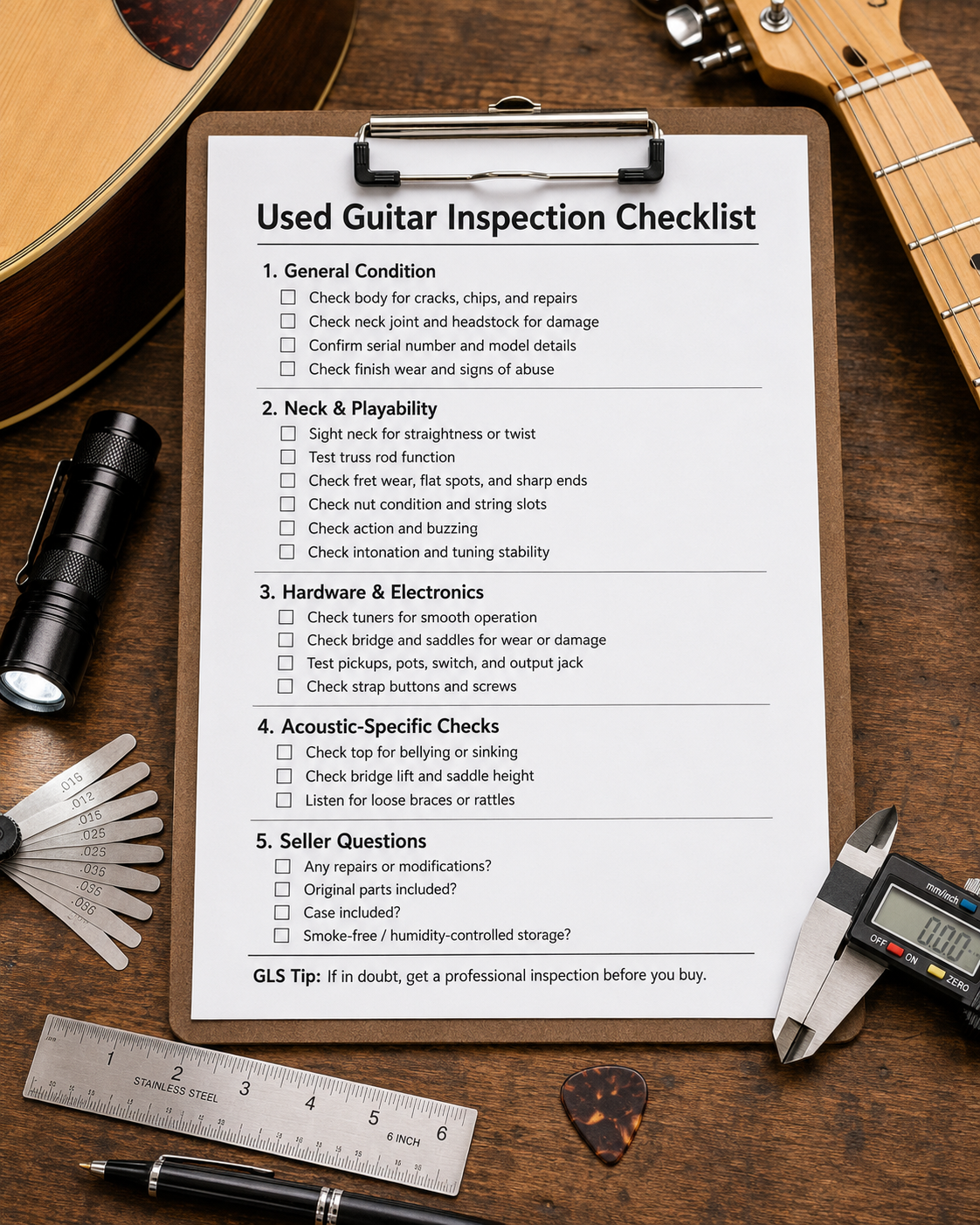
Used Guitars: Value Depends on Condition
A used guitar should not be judged only by brand, age, finish, or asking price. The important question is whether the instrument is structurally sound, playable, serviceable, and priced realistically after any setup or repair work is considered.
Some used guitars only need strings, cleaning, and a proper setup. Others need fretwork, electronics repair, bridge work, nut replacement, saddle work, crack repair, or more serious structural attention. The difference matters before money changes hands.
GLS Note: A cheap used guitar is not automatically a good deal. A fair used price should leave room for known repairs, setup work, and the actual condition of the instrument.
Why Buying Used Can Be Smart
Buying used can be smart when the guitar is in good condition and priced fairly. Many players can get a better instrument used than they could afford new, especially when shopping for mid-level or professional-level guitars.
- Better value: Used guitars often cost less than the same model new.
- Access to discontinued models: Some useful models, finishes, neck shapes, or pickup configurations are no longer produced.
- Less depreciation: A used guitar may already have taken its biggest resale-value drop.
- Upgrade potential: A solid used guitar can be improved with setup, electronics work, hardware replacement, or fretwork if the base instrument is sound.
- Real feel: A used instrument may already reveal how it handles normal playing wear, tuning stability, and setup adjustments.
GLS Note: The best used guitar purchase is not always the cheapest one. It is the one where purchase price, condition, repair needs, and long-term usefulness all make sense together.
When Used Guitars Become Bad Deals
A used guitar becomes a bad deal when the repair cost erases the savings or when the instrument has problems that cannot be corrected economically. Cosmetic wear is often acceptable. Structural problems, neck issues, severe fret wear, or unstable hardware require more caution.
| Issue | Why It Matters | Buyer Risk |
|---|
| Twisted neck | Can create uneven action, buzzing, dead spots, and poor playability. | Often difficult or uneconomical to correct. |
| Non-working truss rod | Limits the ability to set proper neck relief. | Can require major repair or make the guitar impractical. |
| Severe fret wear | Can cause buzzing, poor intonation, and weak bends. | May require leveling, crowning, partial refret, or full refret. |
| Bridge lift on acoustic | Can signal glue failure, top stress, or structural movement. | Repair cost may be significant. |
| Unstable electronics | Intermittent output can make the guitar unreliable. | May need jack, switch, pot, wiring, pickup, or ground repair. |
Buying warning: Do not assume every problem is “just a setup.” High action, tuning instability, fret buzz, and poor intonation can be simple adjustments, but they can also point to deeper issues.
Used Electric Guitar Inspection Checklist
Used electric guitars should be inspected for playability, neck health, fret condition, hardware stability, and electronics function. Plug the guitar into a clean amp if possible and test every control.
- Neck straightness: Sight down the neck from the headstock and body end. Look for twist, severe bow, or uneven relief.
- Truss rod response: Confirm the truss rod is not frozen, stripped, or already maxed out. Do not force it.
- Fret wear: Look for deep grooves, flat frets, uneven frets, sharp fret ends, dead notes, or choking bends.
- Nut condition: Check for cracked nut material, strings sitting too high, strings binding, or open chords playing sharp.
- Bridge and saddles: Look for stripped screws, seized saddles, missing springs, corrosion, poor break angle, or tremolo instability.
- Tuners: Check for slipping, stiffness, missing screws, loose bushings, or inconsistent tuning feel.
- Electronics: Test all pickups, volume controls, tone controls, switches, push-pull pots, coil splits, and the output jack.
- Noise level: Some single-coil hum is normal. Loud crackling, signal dropouts, or dead positions are not normal.
- Body and neck joint: Inspect for cracks, loose neck screws, neck pocket damage, repaired breaks, or signs of impact.
- Intonation range: Saddles should have enough adjustment room. Saddles maxed out in one direction can be a warning sign.
GLS Note: On electrics, small electronics issues are often repairable. Neck problems, major fret issues, and unstable hardware affect the buying decision more heavily.
Used Acoustic Guitar Inspection Checklist
Acoustic guitars require additional caution because the top, bridge, braces, neck angle, saddle height, and humidity history all affect playability and repair cost. Cosmetic wear is common. Structural problems deserve careful inspection.
- Bridge condition: Look for lifting at the back edge, cracks through the bridge, loose bridge wings, or a shaved-down bridge.
- Top condition: Check for cracks, excessive belly behind the bridge, sinking near the soundhole, or distortion around the bridge.
- Saddle height: A very low saddle with high action may indicate neck-angle or structural problems.
- Neck angle: If the action is high and the saddle is already low, the guitar may need more than a basic setup.
- Brace condition: Listen for rattles and gently tap around the top and back. Loose braces may produce buzzing or dull response.
- Cracks: Inspect the top, back, sides, neck heel, headstock, and area near the bridge. Not all cracks are fatal, but they affect value and repair cost.
- Humidity damage: Sharp fret ends, top sinking, cracks, and bridge movement may suggest dryness. Excessive top swelling may suggest over-humidity.
- Frets and fingerboard: Check for grooves, divots, loose frets, lifted fret ends, and fingerboard separation.
- Tuners and hardware: Check tuning stability, loose buttons, stripped screws, and corrosion.
- Pickup system: If it has electronics, test the output, battery compartment, controls, and jack.
Buying warning: High action on an acoustic guitar is not always a simple saddle adjustment. If the saddle is already very low, the guitar may need structural work.
Neck and Truss Rod Red Flags
The neck is one of the most important parts of a used guitar inspection. A good setup depends on a neck that can be adjusted correctly and frets that allow the guitar to play cleanly.
- Twist: One side of the neck appears to rise or fall differently than the other. This is more serious than normal relief.
- Frozen truss rod: The adjustment will not move. Do not force it during a purchase inspection.
- Maxed-out truss rod: The rod has reached the end of adjustment and cannot correct the relief.
- Backbow: The neck curves backward and may cause open-position buzzing or dead notes.
- Excessive forward bow: High action and poor feel may result, especially if the rod cannot correct it.
- Cracks near the headstock or heel: These areas should be inspected carefully, especially on angled-headstock designs.
- Neck joint movement: Loose bolt-on necks, cracked neck pockets, or acoustic neck heel gaps may indicate repair needs.
GLS Note: A playable neck does not need to be visually perfect, but it must be adjustable, stable, and compatible with reasonable action and intonation.
Fret Wear and Playability Problems
Fret condition has a major effect on the real cost of a used guitar. Light fret wear is normal. Deep grooves, flat frets, uneven frets, or loose frets can turn a fair price into a poor purchase.
| Fret Condition | What It Means | Likely Work |
|---|
| Light wear | Small marks under common chord positions, but the guitar plays cleanly. | Setup only, or no immediate fretwork. |
| Moderate wear | Visible flattening or shallow grooves; may affect bends or intonation. | Possible level, crown, and polish. |
| Severe wear | Deep grooves, buzzing, dead spots, or poor note clarity. | Partial refret or full refret may be needed. |
| Uneven frets | Some notes buzz while others are clean, especially with lower action. | Fret leveling or localized correction. |
Buying warning: If the seller says “it just needs strings,” but the frets have deep grooves or the guitar buzzes badly, assume setup alone may not fix it.
Electronics and Hardware Checks
Electric guitars and acoustic-electric guitars should be tested through an amp. Do not rely only on the seller saying the electronics work. Test the full signal path.
- Output jack: Wiggle the cable lightly. Crackling or signal loss may indicate a loose or failing jack.
- Pickup selector: Test every position and listen for dead spots, loud pops, or intermittent signal.
- Volume and tone controls: Rotate each pot fully. Scratchiness may be dirt or wear, but dropouts are more concerning.
- Push-pull or mini switches: Test coil splits, phase switches, active circuits, or boost functions if equipped.
- Active electronics: Check the battery compartment and confirm the guitar works properly with a fresh battery.
- Grounding noise: Some hum is normal with single-coils. Excessive buzz may indicate shielding, grounding, or wiring issues.
- Bridge hardware: Check saddle screws, intonation screws, tremolo posts, springs, and mounting screws.
- Tuners: Make sure each tuner turns smoothly and holds pitch.
- Strap buttons: Loose strap buttons can become a real stage or rehearsal problem.
GLS Note: Electronics repairs are often manageable, but the repair cost should still be considered when negotiating the price.
Acoustic Bridge, Top, and Brace Issues
Acoustic guitars are more sensitive to structural condition than solid-body electrics. The bridge, top, bracing, saddle height, and neck angle all work together. A problem in one area can affect the entire instrument.
- Bridge lift: The back edge of the bridge separates from the top. This should be repaired before it worsens.
- Top belly: Some top movement behind the bridge can be normal, but excessive bulging can indicate stress.
- Top sinking: A sunken top, especially near the soundhole or bridge, may indicate dryness or structural issues.
- Loose braces: Buzzing, rattling, or uneven top response may indicate brace problems.
- Bridge plate wear: String ball ends can damage the bridge plate over time, especially if ignored.
- Low saddle / high action: This combination is a major warning sign because there may be little room left for standard setup adjustment.
- Cracks: Cracks should be evaluated for location, movement, humidity cause, and repair quality.
Buying warning: A low saddle with high action is one of the biggest acoustic-guitar caution signs. It may indicate that the guitar needs structural correction rather than a normal setup.
Common Repair Costs to Consider
Repair prices vary by instrument, location, part availability, and severity of the problem. The ranges below are general planning categories only, not quotes. Always get the instrument inspected before assuming the final cost.
| Work Type | Why It May Be Needed | Cost Impact |
|---|
| Restring and basic cleaning | Old strings, grime, dirty fretboard, hardware buildup. | Usually low. |
| Setup | Action, relief, intonation, pickup height, playability correction. | Common and expected on many used guitars. |
| Nut work | Slots too high, too low, binding, cracked nut, tuning issues. | Moderate depending on adjustment or replacement. |
| Fret level / crown / polish | Uneven frets, moderate wear, buzzing, rough bends. | Moderate to significant. |
| Refret | Severe fret wear, low frets, major playability problems. | Significant. |
| Electronics repair | Noisy pots, bad jack, dead switch, wiring faults, pickup problems. | Low to significant depending on parts and diagnosis. |
| Acoustic bridge or crack repair | Bridge lift, cracks, loose braces, structural movement. | Can be significant and should be evaluated before purchase. |
GLS Note: The real used-guitar price is the purchase price plus the work needed to make it reliable and playable.
Questions to Ask the Seller
A good seller should be willing to answer basic questions. Vague answers do not automatically mean the guitar is bad, but they do mean the buyer should inspect more carefully.
- How long have you owned the guitar?
- Are you the original owner?
- Has the guitar had any repairs, cracks, breaks, or modifications?
- Does the truss rod work?
- Has the guitar had fretwork or a refret?
- Are the electronics original and fully working?
- Does it stay in tune?
- What string gauge and tuning is it currently set up for?
- Has it been stored in a case or controlled humidity environment?
- For acoustics: has the bridge ever lifted or been reglued?
- For guitars with cases: is the case included, original, and functional?
- Why are you selling it?
GLS Note: Seller answers are useful, but they are not a substitute for inspection. Confirm condition with your own eyes and hands whenever possible.
When to Walk Away
Walking away from the wrong guitar is part of buying smart. A deal is only good if the instrument can be made reliable and playable at a total cost that still makes sense.
- The neck appears twisted.
- The truss rod does not work or is already maxed out.
- The guitar has severe fret wear and the seller will not account for it in the price.
- An acoustic has high action and almost no saddle height left.
- The bridge is lifting, cracked, or poorly repaired.
- There are suspicious cracks near the headstock, neck joint, bridge, or body seams.
- The electronics cut in and out during testing.
- The guitar cannot hold tuning after normal playing.
- The seller refuses reasonable inspection or will not allow the guitar to be plugged in.
- The repair cost likely exceeds the value advantage of buying used.
Buying warning: Do not let a rare finish, famous brand name, or “today only” price pressure override basic inspection judgment.
When to Get a Professional Inspection
A professional inspection is especially useful when the guitar is expensive, vintage, acoustic, modified, damaged, or being purchased from a private seller with limited return protection.
- You are buying a guitar over your comfort budget.
- The guitar is acoustic and has high action, low saddle, cracks, or bridge movement.
- The neck or truss rod condition is uncertain.
- You see fret wear but do not know how serious it is.
- You suspect prior repair work.
- The guitar has active electronics or complex switching.
- You are buying for a child, student, gigging player, or recording use and need reliability.
- You are buying online and want an inspection immediately after delivery while return options are still available.
GLS Note: A pre-purchase inspection can help separate normal setup needs from repairs that should change the buying decision.
GLS Local Service CTA for Camarillo / Ventura County
If you are buying a used guitar in Camarillo, Ventura, Oxnard, Thousand Oaks, or the surrounding Ventura County area, Gannon Luthier Services can help inspect the instrument before or shortly after purchase.
GLS can evaluate playability, neck condition, fret wear, nut condition, bridge condition, electronics, hardware, acoustic structural concerns, and setup needs. The goal is simple: help you avoid hidden repair costs and make sure the guitar is worth buying.
Schedule a Used Guitar Inspection
Frequently Asked Questions
Is buying a used guitar a good idea?
Yes, buying used can be a good idea when the instrument is structurally sound, plays well, has reliable hardware and electronics, and is priced fairly after any setup or repair work is considered.
What is the biggest risk when buying a used guitar?
The biggest risk is missing a problem that is expensive to correct, such as a twisted neck, non-working truss rod, severe fret wear, acoustic bridge lift, poor neck angle, structural cracks, or intermittent electronics.
Should I buy a used guitar online?
Buying online can work, but only if there are clear photos, an honest description, a reasonable return policy, and enough time to inspect the guitar after delivery.
Does every used guitar need a setup?
Not every used guitar needs major work, but many benefit from a setup. Setup condition affects action, tuning stability, intonation, pickup height, and overall playability.
Need Help Inspecting a Used Guitar?
Gannon Luthier Services can help evaluate a used electric or acoustic guitar, identify repair concerns, estimate setup needs, and determine whether the instrument is a smart purchase.
Contact GLS About a Used Guitar
Local service area: Gannon Luthier Services provides guitar setup, repair, cleaning, restringing, and instrument evaluation services for players in Camarillo, Ventura County, Thousand Oaks, Oxnard, Ventura, and surrounding Southern California areas.
Return To Blogs